Christmas Tree Shopping, Sans Car
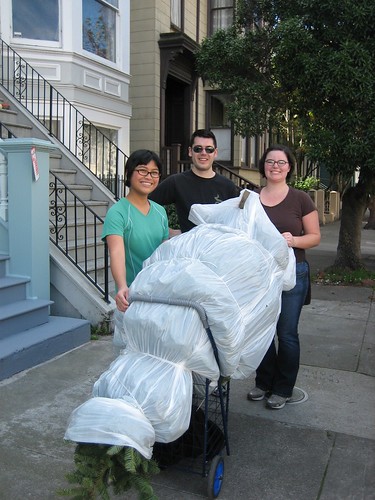 After deciding to buy a giant Christmas tree this year, then walking to the location where we wanted to buy the tree only to find an empty lot, and then taking the bus to a lot quite far from the house, we finally found the tree.
Of course, the tree was at least 20 blocks from our apartment, it was rather heavy, and all we brought with us to help move the tree was a laundry cart. And, as fate would have it, once the stand was nailed into the bottom of the tree it would no longer fit in the laundry cart standing upright.
So how do you walk a Christmas tree home in San Francisco? Lay it across the shopping cart, and have one person push while two people guide the front of the tree. Rotate spots every so often so nobody gets too tired, and be sure to take lots of pictures along the way.
Even though it was the most trying, this is probably the most fun I have had getting a Christmas tree in years.Labels: Carless, Christmas, San Francisco
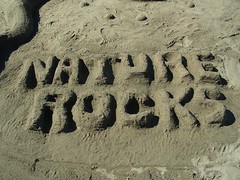
Nature Rocks
Today was the Leap Sandcastle Classic, a kids' competition to see who can build the best thing out of sand. I say thing as oppose to castle because very few of the structures I saw looked remotely like a castle. The theme of the competition was "Nature Rocks," so most of the structures were animals and musical instruments. My favorite was two crocodiles laying in the sun, one on its back and one on its belly. I got there too late to see the construction process (I heard the signal to stop building as I was walking up the beach), but the finished products were mind-boggling nonetheless.
The beach was crowded with kids, their parents, and tons of photographers. Maybe I haven't been getting out much lately, but all of the events I have been to in the city recently (Love Fest, Folsom Street Fair, etc.) have been inundated by photographers. I love that people are out documenting great moments, but what bugs me is that nobody seems to ask permission to take pictures of people anymore. This doesn't apply to structures made of sand as much as it does to actual people, but have photographers gotten so wrapped up in getting a great shot that they forget about the privacy concerns of their subjects? That having been said, please check out my pics from the event on Flickr (click the "Nature Rocks" photo in this post for a quick link). I apologize to any event-goers caught in the background.
Oh! How can I write about this event and neglect the best part of the day! The weather was amazing, especially for Ocean Beach. I think I may have even toasted my face a little.
After the event Mom, Zeph, and I had linner (dunch?) at the Beach Chalet, and Mom was even nice enough to drive us home. I love being able to spend time with my mom, although I wish she and Zeph wouldn't pick on me so much when we get together. Isn't she supposed to take the biological child's side? On the other hand, I guess I shouldn't complain that my mom and my partner get along so well that they gang up on me; It's better than having them gang up on each other.
And now I am off to play Halo 3 with my honey. The end to a perfect Saturday...Labels: San Francisco, Sandcastle Classic
The Haight and my Intro Class
Before this rant (or, as I like to think of it, scholarly musing) begins, let me give some background information. Last week the assignment in my intro to media studies class was to collect artifacts that represented the Haight Ashbury district of San Francisco in the 1960s and post it on our class message board. Then, the class took a field trip to the Haight (which is about 6 blocks from USF) and collected artifacts from today's Haight, which included interviews, photos, and video. These artifacts were also posted to the message board, and old Haight and new Haight were compared.
A surprising number of students wrote about the commercialization of Haight and about the neighborhood today the neighborhood being a symbol of materialism and capitalism. While the Haight is probably more commercial than it was in the '60s, it is problematic, and even somewhat untrue, to make such a blanket, black-and-white statement.
Let me explain further...
It is true during the '60s there were programs dedicated to free everything, including housing, food, and medical care. But some of the hippies did buy stuff, if only food, drugs, or the latest LP. I agree that they probably didn't buy 15 pairs of shoes (which, unfortunately is soooo easy to do in the Haight), but some of them had at least one pair. Therefore, while not overly materialistic, the hippies did buy things, and thus there have always been stores in the Haight.
Furthermore, to chastise the Haight for becoming overly commercialized is to ignore all of the counter-capitalist businesses that exist there. My favorite example of such a business is Coffee to the People, a cafe that only sells organic, fair trade coffee and tea. Although a coffee shop, it is far from Starbucks, and the fact that it is still in business (I am unsure when it opened) is a testament to the fact that businesses that treat their workers, the environment, their suppliers, and their customers with respect can still be profitable.
Even though there exist many other stores which probably don't dig as deeply into the origins of their products as Coffee to the People does, most of the businesses are small rather than corporate. In fact, San Francisco Law requires that any "formula retail" establishment apply for a special permit before setting up shop in the Haight. The only large corporations that come to mind when I think of the Haight are McDonalds, Ben & Jerry's and Wells Fargo (the Gap recently closed its Haight & Ashbury location), and of those three I know that at least one (Wells Fargo) is so environmentally friendly that it was awarded a "Green Business" status by San Francisco Green Business.
The other aspect of Haight that makes it anti-capitalist is the wide array of second-hand stores. While I can't find any good evidence to support the claim that second-hand stores are anti-capitalist (at least in the 5 minutes of googling I did), it seems intuitive to me that by buying something used the corporation that manufactured the good doesn't get any more money for the item, and instead a local business profits. Furthermore, something new didn't have to be created, packaged, and shipped, so the impact on the environment is less for second-hand goods (if even No Impact Man will buy second-hand goods, then they must have less environmental impact).
In short (if only brevity were my strong point...) there are stores in the Haight that sell things, but a closer look at the structure, type, and products of the stores receals that the neighborhood is far from an all-consuming, materialist, capitalist beast (or at least as far from it as the Haight is from Union Square).
I promise that not all of my future blog posts will be this academic, nor this long (well, I kinda promise that), so please stay tuned for more!Labels: San Francisco, USF